Il canto dell’aurora
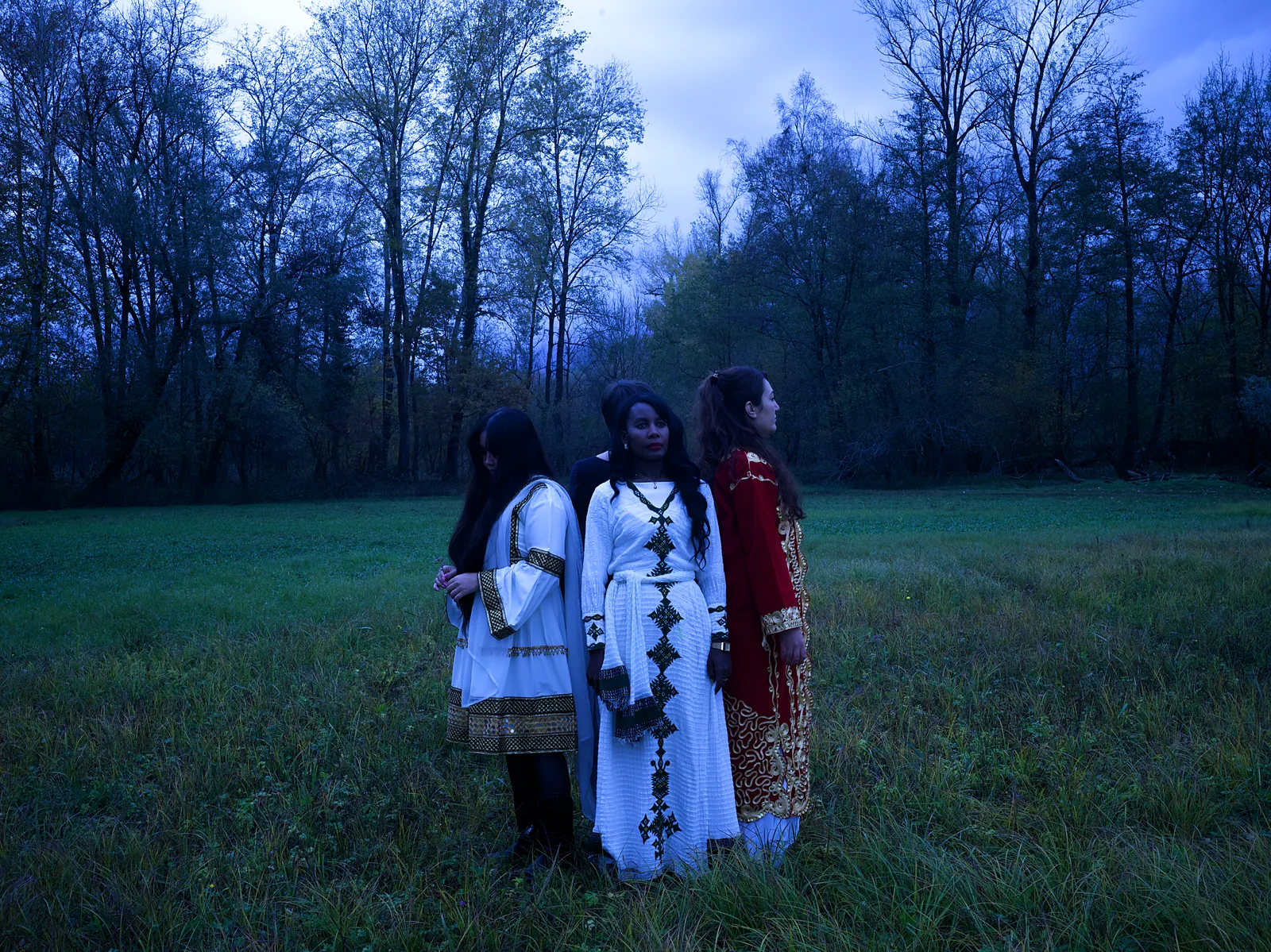
The Song of Dawn
Abdelaziz Zerrou
Performative video, 2026
Bolle di Magadino, Ticino, Switzerland
This project grew out of a painting deeply rooted in the visual memory of Ticino: Luigi Rossi’s Il canto dell’aurora (1910–1912), held at MASI as part of the City of Lugano’s collection. In this work, female figures, the light of dawn and the surrounding landscape come together to evoke an imagined community, a shared territory and a sense of collective identity.
What interests me about this painting is not so much what it tells us about its own time, but what it might still tell us today. I approach it as an open image, one that can be inhabited differently, allowing new voices and stories to emerge.
What does it mean today to sing one's belonging to a country? To whom does the voice of a nation belong?
I invited four women who have found refuge in Switzerland to perform the Swiss national anthem in Ukrainian, Dari, Tigrinya and Turkish. As the anthem moves from one language to another, it begins to change. It takes on different sounds and sensibilities, carrying intimate memories and personal histories of displacement. A collective symbol becomes a space for deeply individual expression.
The performance unfolds at dawn in the Bolle di Magadino, a nature reserve where land and water meet, offering a place of passage and refuge for migratory birds. Shaped by movement, departures and returns, this landscape quietly resonates with the journeys of the four women. It becomes a territory in which borders, passage and belonging acquire both an emotional and a political dimension.
The camera remains at ground level, at human height. It follows bodies, gestures, gazes and moments of silence. Somewhere between contemplative cinema and tableau vivant, the film unfolds to the rhythm of voices, the breathing of the landscape and the emerging light. It makes room for vulnerability, anticipation and all that sometimes escapes words.
The female figures in Rossi’s painting take on a new presence. They are no longer simply symbolic representations of a community, but individuals whose bodies and voices carry stories of their own.
As a Swiss artist of Moroccan origin, questions of belonging also run through my own life. My intention is not to define what it means to be Swiss, but to open a space for listening, where different ways of inhabiting the same territory can coexist.
Il canto dell’aurora explores the distance between the “we” constructed through national symbols and the one that emerges, day by day, within the reality of a plural society.
Perhaps collective identity is not something we simply inherit. Perhaps it is also something we create through encounters, through listening and through our willingness to make room for other voices.
Like the dawn, beginning anew each morning.